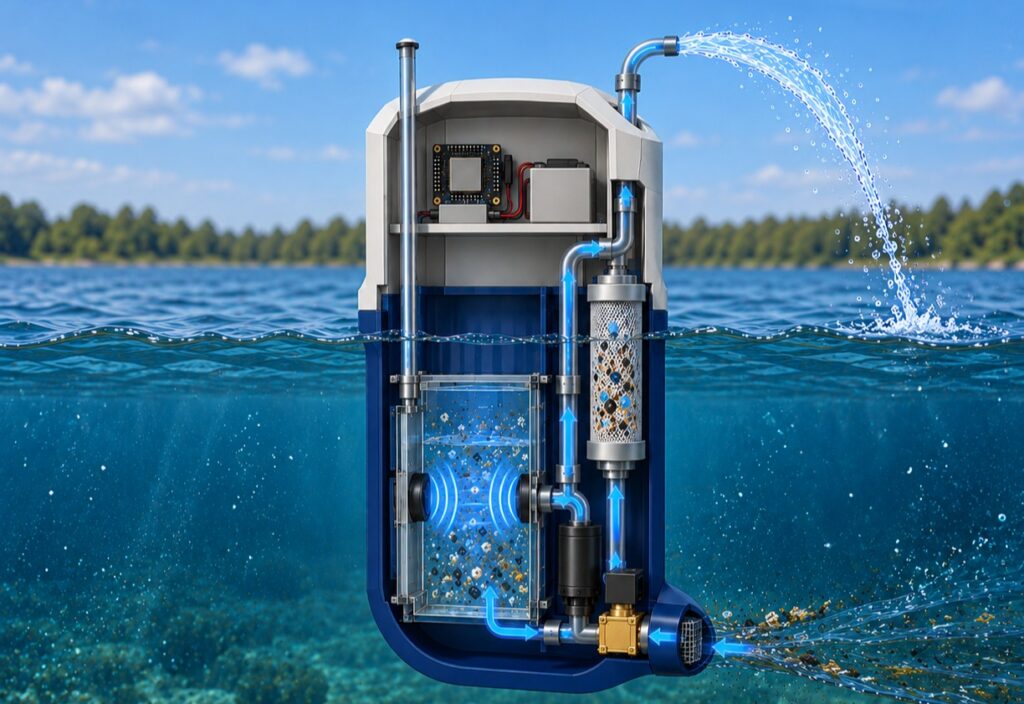

project_buyok.
An autonomous floating device for cleaning water bodies of microplastics, combining ultrasonic particle concentration with mechanical filtration.
 Grade 10
 Kyiv
Why Іван Забіла Олександрович created the project_buyok.
Every year, millions of tons of plastic waste end up in aquatic ecosystems. Over time, under the influence of sunlight, waves, and mechanical friction, plastic breaks down into increasingly smaller particles. And while a plastic bottle can be seen and caught, what do you do with millions of particles that are almost impossible to notice with the naked eye? Microplastics spread with currents, enter the bodies of aquatic organisms, and can be passed along food chains. Today, specialized vessels, floating barriers, and filtration systems are used to clean water bodies. However, most of these systems are designed for large debris. To capture increasingly smaller particles, filters with smaller openings are required, which clog faster and need regular maintenance. Moreover, large cleanup vessels require fuel, personnel, and significant human labor costs, and using overly fine nets in open waters can pose a threat to plankton and other small organisms.
Small particles — big problems.
— Іван Забіла ОлександровичHow the project_buyok works.
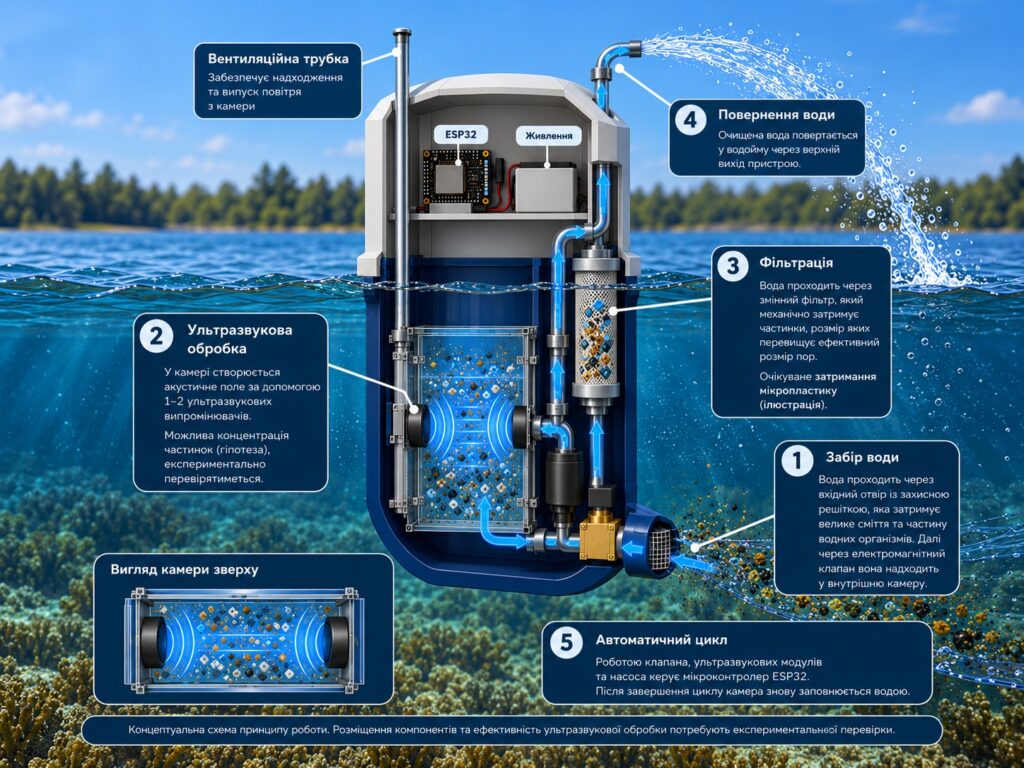
First, water from the water body passes through a protective grille that retains large debris and some aquatic organisms, preventing them from entering the device. Through an electromagnetic valve, it flows into a special internal chamber, which automatically closes the valve once filled.Next, the ultrasonic emitters are activated. The acoustic field they create is intended to promote the movement and concentration of microplastic particles in certain areas of the chamber, as well as the potential formation of larger clusters.After the ultrasonic treatment is complete, a pump forces the water through a replaceable mechanical filter that retains particles according to the size of its pores. Experiments will test whether ultrasound helps more effectively capture finer microplastics and whether the formed agglomerates remain intact after the emitters are switched off.The filtered water returns to the water body through the device's upper outlet, after which the chamber refills with water.In the future, it is planned to install a surveillance camera and a spectral sensor for additional water analysis and evaluation of cleaning results. The material accumulated in the replaceable filter will be removed during regular maintenance for further research and proper disposal.

Are you a student inventor?
If you have an idea to solve a real problem in your community, we want to hear from you.

0 comments.
Sign in to join the conversation.