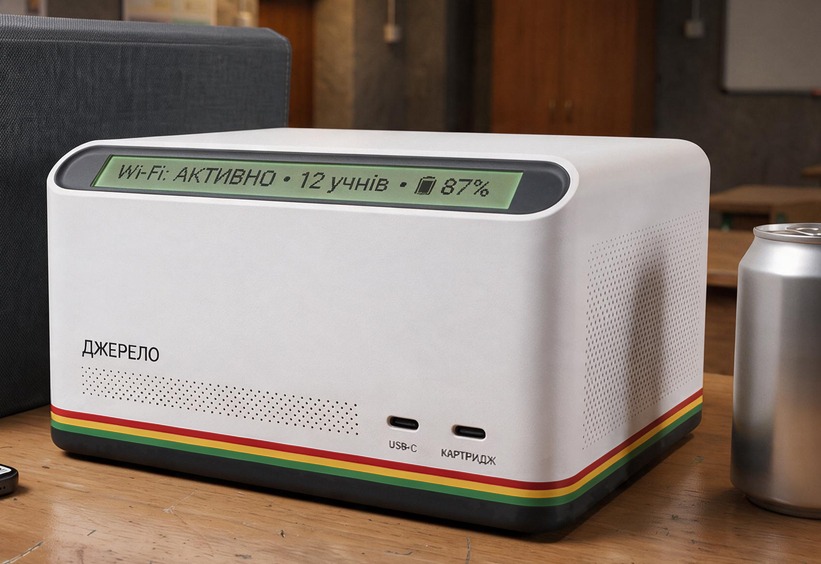

ДЖЕРЕЛО (Dzherelo).
Autonomous station with local AI for schools without electricity or network connectivity.
 Grade 9
 Kharkiv, Kharkivska Oblast
Why Nazar Zheliezniakov created the ДЖЕРЕЛО (Dzherelo).
I live in Kharkiv and I've already gotten used to planning my day around the blackout schedule. In January 2026, after a strike on the power grid, around 80% of the city was left without electricity. In my neighborhood there was no power or internet for days. Lessons kept getting cancelled. There was nowhere to check homework.By May 2026, more than 65% of educational institutions in Kharkiv had been damaged. Some classes moved into shelters. There's no network there, and often no power outlets either. An online lesson simply won't load. The textbook stays at home or in the classroom, and carrying it with you during an air raid alert is extra weight you don't need. Across the country the problem is even bigger. In November 2025, Save the Children reported that around 930,000 children in Ukraine have lost normal schooling because of the war and strikes on the energy grid. Parents buy power banks, schools install generators. A generator gives you light. It doesn't give you a teacher nearby.I tested this on myself: without the internet, a phone is just a brick with a camera. An offline book opens fine, but you can't talk to it. The page just sits there. What I needed was something that could explain a topic from the textbook, show the page, and not disappear along with the network. That's how I built DZHERELO.
Without internet, a phone is just a brick with a camera.
— Nazar ZheliezniakovHow the ДЖЕРЕЛО (Dzherelo) works.
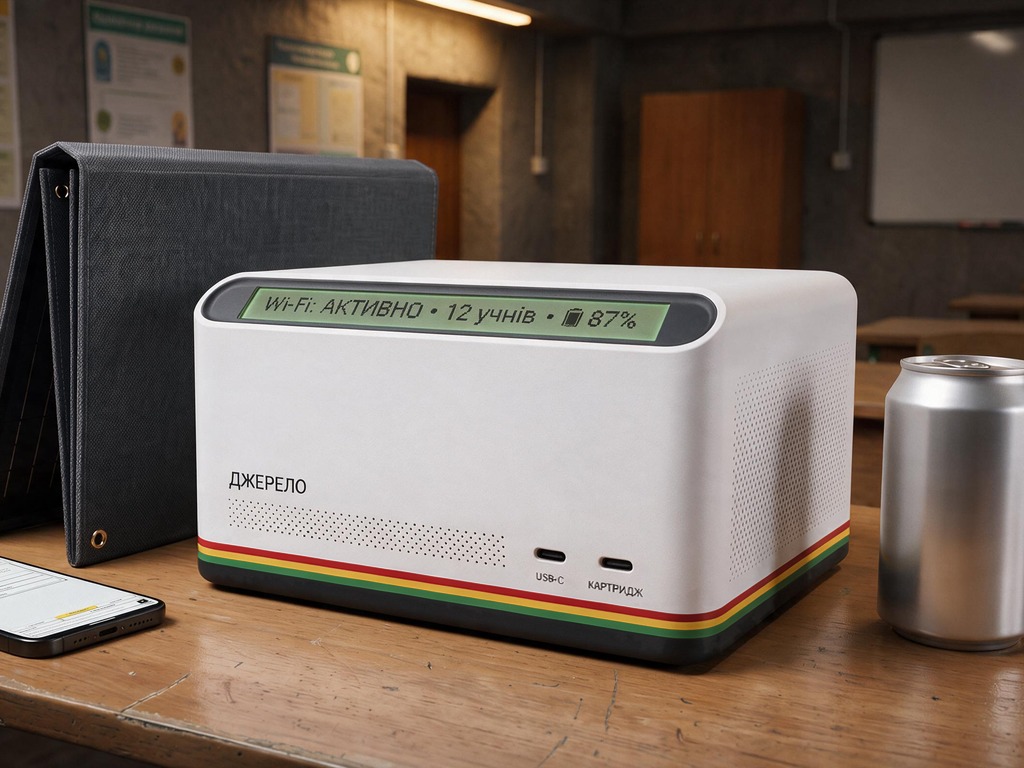
DZHERELO - a box about the size of a lunchbox. Inside it has a Raspberry Pi 5, a battery, and a slot for a textbook cartridge. The station broadcasts its own Wi-Fi network. No internet is needed for this.The student opens a browser on their phone, selects their grade, and enters a four-digit PIN. There's no app to install. The network code is printed on the case.Then you type your question. The Gemma 4 QAT model searches for the answer in the Ministry of Education textbooks stored on the station and cites the source: PHYSICS 9, page 26. Tap the source and that page opens, with its formulas and illustrations. You can leave the book at home. If the textbook doesn't have the answer, the station says so - it won't guess on its own.The explanation can be made shorter or longer: a hint, a step-by-step walkthrough, or a full breakdown. The hint doesn't give the ready answer - it gives a leading question. There's also a "similar problem" button: same formulas, different numbers, 3 difficulty levels. Your deskmate can't just copy off you with this.The teacher has their own login, with the code also printed on the case. They set deadlines, add materials via a USB cartridge, and see the class profiles. Deadlines live on the station, no internet required. A read-aloud button reads the answer out loud using Supertonic 3. This is for those who find it hard to read from a screen.If the whole class is typing at once, requests go in a queue. The battery lasts for 2 school days. It charges

Are you a student inventor?
If you have an idea to solve a real problem in your community, we want to hear from you.

0 comments.
Sign in to join the conversation.