
ResQ.
An autonomous multi-sensor module for search-and-rescue missions that detects survivors and their biological data through rubble and smoke using LiDAR and mmWave radar.
 Grade 11
 Kyiv
Why Кислухін Єгор created the ResQ.
Today, due to the consequences of military actions, rescuers, medics, and military personnel are forced to risk their own lives daily to save people trapped in half-destroyed buildings, rubble, and hard-to-reach places. Narrow cavities beneath rubble, unstable concrete slabs, shafts, or partially collapsed tunnels create an enormous risk of repeated collapse during any attempt at manual penetration. An additional barrier is the extreme environment inside the rubble: thick smoke, construction dust, and darkness render ordinary cameras useless, while thermal imagers often distort the picture due to heated debris and smoldering. Time for rescue is measured in minutes, yet checking for living people without direct contact using classical means is practically impossible. The ResQ invention was born out of the need to eliminate this risk. The main goal of the project is to create an autonomous module capable of safely penetrating hard-to-reach and dangerous crevices, conducting reconnaissance, and remotely detecting signs of human life through physical obstacles by micro-movements of breathing and heartbeat, thereby preserving the lives of both victims and those coming to their rescue.
How the ResQ works.
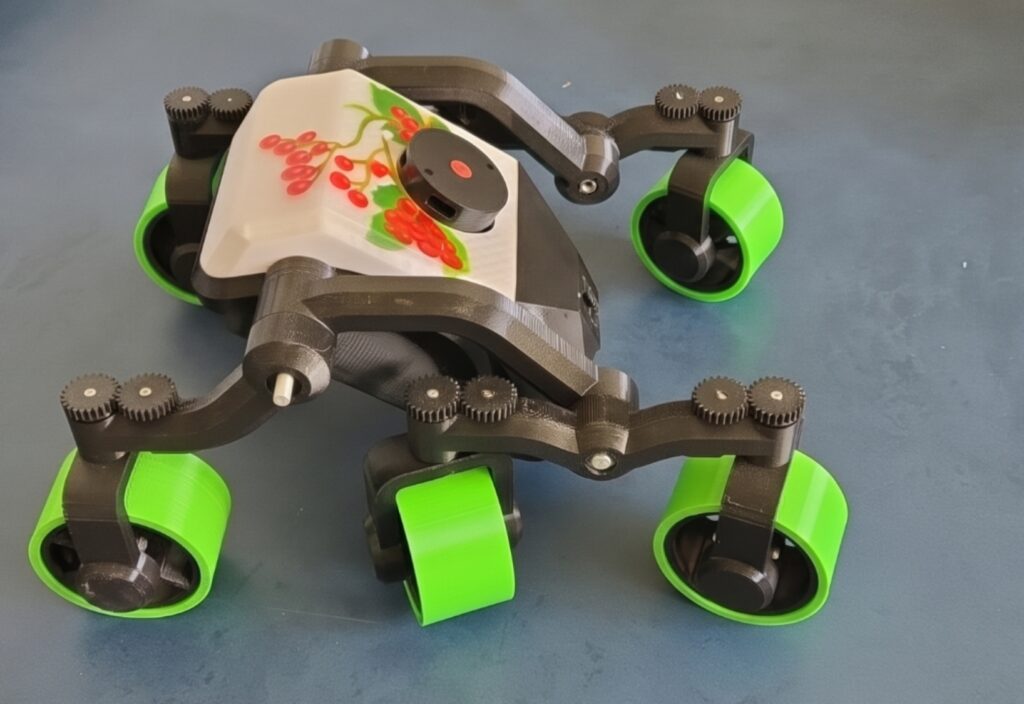
- Obstacle negotiation: a chassis with an independent rocker-bogie suspension ensures constant wheel contact with the surface and allows the module to stably overcome broken bricks, height differences, and unstable rubble.
- Spatial mapping (SLAM): a DToF LiDAR performs a 360-degree laser scan, forming an accurate real-time 2D/3D map of the premises. Stereo cameras complement it with a depth map, providing orientation both in complete darkness and in low-light conditions.
- Detecting life through obstacles: an mmWave radar emits millimeter waves that freely penetrate dense smoke, construction dust, drywall, and loose debris. Thanks to its high sensitivity, the radar detects sub-millimeter vibrations — the micro-movements of a person's chest during breathing and their pulse.
https://www.canva.com/design/DAHJLVAlv54/hgCveAQAV0ka0e2XPaYohw/edit
— Кислухін Єгор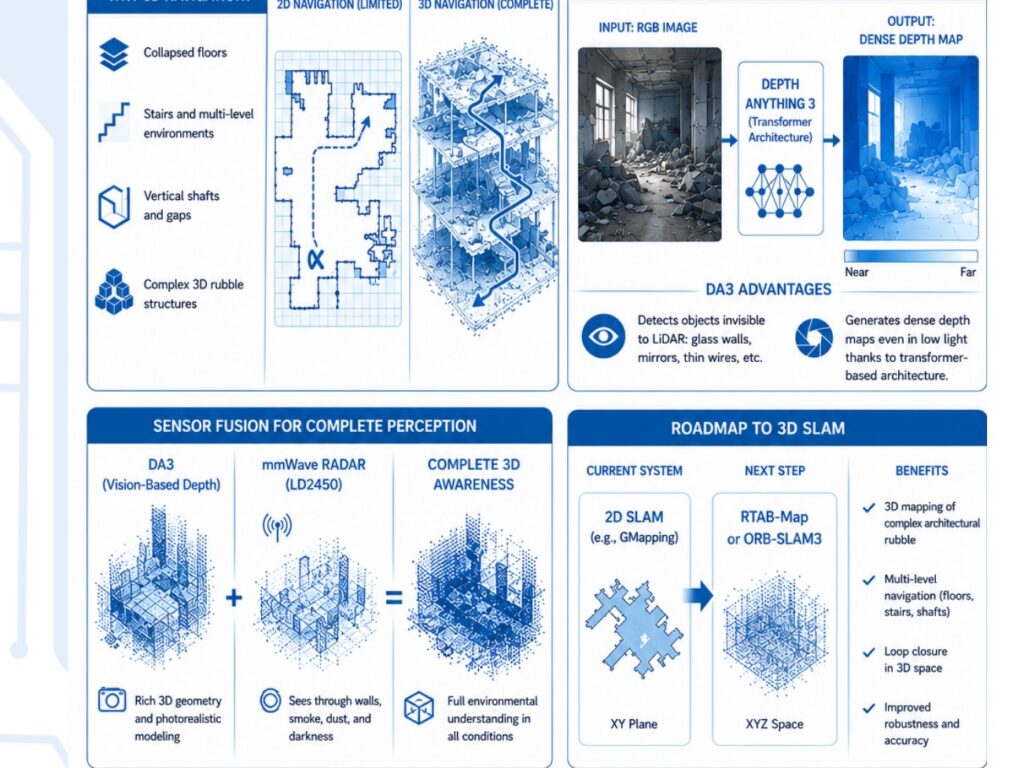

Are you a student inventor?
If you have an idea to solve a real problem in your community, we want to hear from you.

0 comments.
Sign in to join the conversation.